Introduction about How an MVNO Platform Works
Launching a Mobile Virtual Network Operator means building a business on top of borrowed infrastructure. But between a wholesale agreement with a Mobile Network Operator (MNO) and a paying subscriber using their phone, there is a sophisticated layer of technology that makes everything work: the MVNO platform. This platform is the operational heart of every mobile brand. It handles activations, charges calls, enforces data policies, routes customer care interactions, and generates the invoices that keep the business running. Understanding how an MVNO platform works is not just a technical exercise. It is a strategic imperative for every entrepreneur, investor, or operator who wants to build a sustainable mobile business.
Whether you are starting your own MVNO from scratch or evaluating how to upgrade an existing operation, this guide walks you through every layer of the platform: what it is, how it connects, which models you can choose, and what it means for your organisation from day one.
What are the details of How an MVNO Platform Works?
- History and evolution of the MVNO Platform
- Core concept: What an MVNO Platform actually is
- Technical integration and data flow
- MVNO Platform models: Build, Buy, or Partner
- Organizational impact of the MVNO platform
- A Subscriber Journey Through the MVNO Platform
- Frequently Asked Questions about How an MVNO Platform Works
- Take the next step
History and evolution of the MVNO Platform
The first MVNOs appeared in the late 1990s, initially operating with minimal technology stacks. They relied almost entirely on the MNO for billing, provisioning, and customer management. Over time, competitive pressure and subscriber expectations forced MVNOs to take ownership of more platform components. The arrival of cloud computing, open APIs, and virtualised network functions accelerated this shift dramatically. Today, a modern MVNO platform can be deployed in weeks, not years, and scaled to millions of subscribers without owning a single physical rack.
Core Concept: What an MVNO Platform actually is
The Platform Defined
At its most fundamental level, an MVNO platform is the integrated set of systems and software that allows a virtual operator to manage subscribers, control services, process charges, and interact with the host MNO network. It sits between the MNO’s core network and the MVNO’s own business operations, translating raw network events (a call, a data session, a text message) into business outcomes (a charge, a policy action, a customer record update).
The platform is not a single product. It is an ecosystem of interconnected components, each responsible for a distinct operational function. Some MVNOs build this ecosystem themselves, some buy it as a pre-integrated stack, and others outsource it entirely to an MVNE or MVNA. Regardless of the model, the components themselves remain largely the same. What changes is who owns, operates, and integrates them.
Understanding the platform also means understanding the broader types of MVNOs that exist in the market. A discount MVNO, an enterprise MVNO, and an IoT MVNO all use a platform, but their requirements differ significantly in terms of charging logic, policy control, and subscriber management complexity.
The Key components of an MVNO Platform
An MVNO platform consists of several tightly coupled components. Together they form the operational backbone of the business.
Business Support Systems (BSS) handle the commercial side of the operation. The BSS covers subscriber management, product catalogue, order management, billing, and revenue management. When a customer buys a SIM, activates a plan, or receives an invoice, the BSS orchestrates every step. MVNO Index provides a dedicated resource explaining what a Business Support System is and how it applies to a virtual operator context.
Operational Support Systems (OSS) manage the technical and service side. The OSS covers provisioning, network inventory, fault management, and service assurance. When a SIM needs to be activated on the MNO network or a configuration change needs to propagate, the OSS executes the instruction. Read more about what an Operational Support System is and how it differs from BSS in an MVNO context.
The Online Charging System (OCS) controls real-time usage and balance management. For prepaid subscribers especially, the OCS authorises each service event in real time, deducting credit as calls are made, data is consumed, or messages are sent. The Online Charging System is one of the most latency-sensitive components in the entire platform.
The Home Subscriber Server (HSS) or its legacy equivalent, the Home Location Register (HLR), holds the subscriber profile database. It stores authentication keys, service entitlements, and roaming permissions. Every time a subscriber’s device attaches to the network, the MNO queries this database to verify identity and retrieve service settings.
The Policy and Charging Rules Function (PCRF) enforces data policies in real time. It determines how much bandwidth a subscriber receives, whether fair-use limits apply, and how to treat different types of traffic. The PCRF works together with the OCS to deliver a seamless experience while protecting the MVNO from unexpected cost overruns.
CRM and Customer Care tooling integrates with the BSS to give agents and self-service portals a unified view of every subscriber. This layer handles complaints, plan changes, top-ups, and retention workflows. A well-integrated CRM is one of the most visible differentiators in delivering exceptional customer care.
Technical Integration and Data Flow
How the components connect to each other
The components of an MVNO platform do not operate in isolation. They exchange data continuously through a combination of standard telecom protocols and modern APIs. Understanding this flow helps you design a platform that is both resilient and scalable.
The BSS and OSS form the top layer. When a customer order arrives (via a web shop, an app, or a retail channel), the BSS captures it, creates a subscriber record, and instructs the OSS to provision the service. The OSS then communicates with the HLR or HSS to create the subscriber profile, and with the SIM management platform to activate the physical or embedded SIM. This provisioning chain typically completes within seconds on a modern platform.
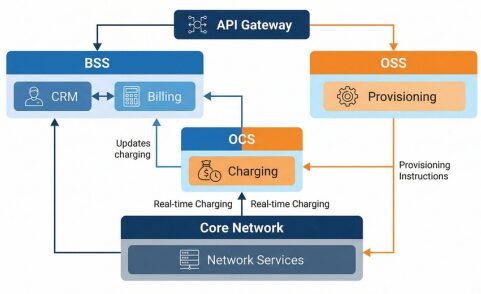
The charging layer sits beneath the service layer. The OCS connects to the core network via real-time charging interfaces (Gy/Ro for 4G). As a subscriber consumes services, usage events flow from the network to the OCS, which validates them against the subscriber’s balance and policy profile. The PCRF connects via the Gx interface, receiving session establishment requests from the network and returning policy rules that govern how the session behaves.
Reporting and analytics tools sit across all layers, consuming data from the BSS, OSS, and charging systems to generate business intelligence dashboards, fraud alerts, and regulatory reports. A well-integrated analytics layer transforms raw network events into actionable business insights. You can explore how to select the right BSS and OSS for your specific requirements on MVNO Index.
How the MVNO Platform Connects to the MNO Network
The interface between the MVNO platform and the MNO’s network is governed primarily by the wholesale agreement negotiated between the two parties. This agreement defines not only commercial terms but also the technical access model: which network elements the MVNO controls, which remain under the MNO’s management, and how the two systems exchange data.
In a light MVNO model, the MNO handles most platform functions. The MVNO connects primarily at the billing and customer management level, with limited direct access to core network elements. In a full MVNO model, the operator deploys its own core network elements, including its own HSS, OCS, and PCRF, and connects to the MNO’s radio access network via standard interconnects.
In a 4G/LTE environment, the primary interfaces between the MVNO core and the MNO network pass through the Serving Gateway and the Packet Data Network Gateway. In a 5G Core deployment, the architecture shifts to a service-based model, where network functions communicate through APIs rather than point-to-point protocols, making integration more flexible but also more complex to orchestrate.
Roaming adds a further dimension. When a subscriber travels outside the MNO’s home network, the MVNO platform must manage roaming agreements, inter-operator settlements, and real-time policy enforcement. This is a specialist area covered in detail in the roaming for MVNOs guide on MVNO Index.
MVNO Platform Models: Build, Buy, or Partner
Choosing Your Platform Model
One of the most consequential decisions any new MVNO makes is how to acquire and operate its platform. Three primary models exist, each with different implications for cost, speed to market, control, and long-term flexibility. You do not need to commit to a single model permanently. Many operators start in one model and migrate to another as they grow.
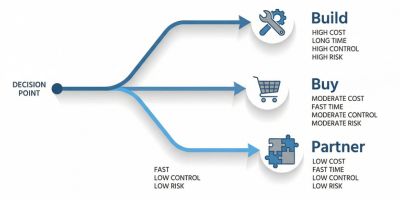
The Build model means the MVNO procures and integrates individual platform components independently. The operator selects a BSS provider, an OSS provider, a core network stack, and a charging system, then integrates them into a functioning whole. This delivers maximum control and the ability to customise every aspect of the platform to match the business model. It is the preferred route for full MVNOs and operators with highly specific technical requirements.
The Buy model means procuring a pre-integrated MVNO platform from a single vendor. These turnkey stacks bundle BSS, OSS, charging, and often SIM management into a single solution with predefined integrations. Procurement and deployment times shrink dramatically compared to the build approach, and the integration risk is largely transferred to the vendor.
The Partner model means working with an MVNE (Mobile Virtual Network Enabler) or MVNA, which operates the platform on the MVNO’s behalf. The MVNO focuses entirely on its brand, sales, and customer experience while the MVNE manages the underlying technology. This is the fastest and lowest-cost route to market.
Browse the full directory of MVNO solution providers and MVNEs on MVNO Index to find and compare vendors that match your business requirements.
Advantages and Disadvantages of of Each Approach
The Build model gives the MVNO full ownership of its technology roadmap. The operator can respond quickly to new product ideas, negotiate directly with each technology vendor, and avoid dependency on a single platform supplier. The disadvantages are significant, however. Integration projects are complex, expensive, and time-consuming. Maintaining a multi-vendor stack requires deep internal technical expertise, and troubleshooting issues across component boundaries can be slow and costly.
The Buy model accelerates deployment and reduces integration risk. A pre-integrated stack from a reputable vendor comes with tested interfaces, pre-built connectors to major MNO networks, and vendor support. The tradeoff is reduced flexibility. Pre-integrated platforms impose their own data models and workflows, and customising them beyond their design parameters is rarely straightforward. Vendor lock-in is a genuine risk if the relationship or the vendor’s roadmap does not evolve in the direction the MVNO needs.
The Partner model through an MVNE delivers the fastest path to revenue. It requires minimal upfront capital investment in technology, and the operational burden of maintaining the platform falls on the enabler. The MVNO gains access to a production-grade platform with established MNO relationships already in place. The cost is ongoing dependency on the MVNE for every technical change and, in many cases, reduced margin compared to owning the platform outright. As the MVNO scales, the economics of the partner model typically become less favourable, which is why many operators migrate from MVNE-hosted to owned platforms as subscriber numbers grow. Working with a consultancy can help you model the financial breakeven point between models for your specific business case.
A Subscriber Journey Through the MVNO Platform
The clearest way to understand how all these components work together is to follow a single subscriber through the platform from the moment they decide to join.
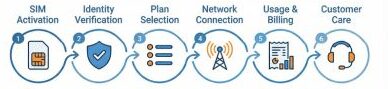
Acquisition and ordering. A potential subscriber visits the MVNO’s website, selects a plan, and completes an order. The web shop captures the order and passes it to the BSS, which creates a new subscriber account, assigns a MSISDN (the subscriber’s phone number), and generates an order for SIM fulfilment or eSIM provisioning.
Provisioning. The OSS receives the provisioning instruction from the BSS and communicates with the HLR or HSS to create the subscriber profile. Authentication keys are programmed into the SIM or downloaded over the air to the eSIM. The subscriber’s service entitlements (voice, data, SMS allowances) are written into the profile and synchronised with the OCS and PCRF.
First network attachment. The subscriber inserts the SIM or downloads the eSIM profile and powers on their device. The device sends an attach request to the MNO’s radio access network, which forwards it to the core network. The Mobility Management Entity queries the HSS to authenticate the subscriber and retrieve their service profile. Authentication succeeds, a data session is established via the Serving Gateway and PDN Gateway, and the PCRF applies the subscriber’s data policy.
Active usage. As the subscriber browses, calls, or messages, usage events flow in real time to the OCS via the Gy/Ro interface. The OCS decrements the subscriber’s balance or bundle allowance with each event. When a bundle threshold is reached, the PCRF receives an instruction to modify the session (for example, to reduce data speed or block access), consistent with the plan the subscriber purchased. All usage records are collected by the Offline Charging System for post-processing and invoice generation.
Customer care interaction. The subscriber contacts support to query a charge. The CRM system pulls a full event history from the BSS and displays it to the agent. The agent resolves the query, applies a credit to the account via the BSS, and closes the ticket. The subscriber receives an automated confirmation via SMS or email, triggered by the CRM workflow.
Plan change and renewal. The subscriber upgrades their plan via the self-service app. The BSS processes the commercial change, updates the subscriber’s product catalogue entry, and instructs the OCS and PCRF to apply the new allowances and policy rules. The change takes effect immediately, without requiring any physical intervention or SIM swap.
This end-to-end journey, from order to usage to support, runs entirely through the MVNO platform. Every component plays a role. Every integration point matters. And every failure, whether a provisioning delay or a charging error, becomes visible to the subscriber within seconds.
Frequently Asked Questions about the Rich Communication Services (RCS)
What is an MVNO platform and what does it do?
An MVNO platform is the integrated set of systems and software that allows a Mobile Virtual Network Operator to run its mobile business. It manages everything that happens between the MNO’s network and the subscriber: activating SIM cards, authenticating devices, charging for calls and data, enforcing service policies, generating invoices, and handling customer care interactions. Without a platform, an MVNO cannot provision a subscriber, charge for usage, or manage a single service event. The platform translates raw network activity into the commercial and operational outcomes that make a mobile business viable.
What are the core components of an MVNO platform?
The core components of an MVNO platform are the Business Support System (BSS), the Operational Support System (OSS), the Online Charging System (OCS), the Home Subscriber Server (HSS) or Home Location Register (HLR), the Policy and Charging Rules Function (PCRF), SIM and eSIM management tools, and CRM or customer care tooling. The BSS handles billing, subscriber management, and product catalogues. The OSS handles provisioning and service activation. The OCS manages real-time charging. The HSS or HLR stores subscriber profiles and authentication credentials. The PCRF enforces data policies. Together these components form the full operational backbone of the MVNO.
What is the difference between a light MVNO and a full MVNO platform?
A light MVNO platform relies heavily on the host MNO for core network functions such as charging, authentication, and policy control. The light MVNO typically manages only its own branding, customer care, and commercial offer, while the MNO operates the underlying technology. A full MVNO platform means the operator deploys and controls its own core network elements, including its own OCS, HSS, and PCRF, connecting to the MNO’s radio access network as a pure connectivity layer. Full MVNO operators carry more technology cost and complexity but gain complete control over their service offering, charging logic, and subscriber data. The types of MVNOs page on MVNO Index explains the full spectrum of MVNO models in detail.
Should a new MVNO build, buy, or partner for its platform?
The right answer depends on your available capital, your target time to market, your technical resources, and your long-term growth ambitions. A new MVNO with limited funding and a need for rapid launch should strongly consider partnering with an MVNE, which hosts and operates the platform on the MVNO’s behalf. A buy model (a pre-integrated turnkey stack from a single vendor) suits operators who want more control but do not want to manage multi-vendor integration. A build model suits full MVNOs with deep technical expertise and a product roadmap that demands maximum platform flexibility. Many successful operators start on an MVNE-hosted platform and migrate to an owned stack as subscriber volumes and margin requirements make that transition commercially justified.
How does the MVNO platform connect to the MNO network?
The MVNO platform connects to the MNO’s network through interfaces defined in the wholesale agreement between the two parties. In a 4G/LTE environment, the MVNO’s core network elements connect to the MNO’s radio access network via the Serving Gateway (S-GW) and Packet Data Network Gateway (PGW). Charging interfaces (Gy/Ro) carry real-time usage events from the network to the MVNO’s OCS. Policy interfaces (Gx) allow the PCRF to apply service rules to active data sessions. In a 5G Core deployment, these interfaces shift to a service-based architecture using APIs. The depth of the technical connection varies by MVNO type: a light MVNO may only connect at the billing level, while a full MVNO maintains direct interfaces into the core network itself.
Take the Next Step
Understanding how an MVNO platform works is the foundation for making the right technology, operational, and commercial decisions as you build your mobile business. If you are ready to move from understanding to action, MVNO Index offers the resources you need at every stage.
Explore how to start your own mobile brand, learn how to find and select the right solution provider, or browse the complete glossary of telecom terms and abbreviations to sharpen your technical vocabulary. The platform is where strategy meets execution. Build it right, and your mobile brand will scale. Build it wrong, and every subscriber interaction will expose the gaps.
Subjects about how to start your own Mobile Brand