SGP.32
As global IoT deployments scale toward billions of “headless” devices, the limitations of legacy SIM standards have become a critical bottleneck. GSMA SGP.32 represents the industry’s first purpose-built response, a revolutionary “Zero-Touch” eSIM architecture that eliminates physical SIM swaps and operator lock-in. By replacing manual intervention with automated, server-driven orchestration, SGP.32 enables enterprises to manage massive fleets across diverse MVNO networks with unprecedented commercial flexibility and operational efficiency.
What is SGP.32 IoT connectivity?
1. Introduction about SGP.32
2. The history and evolution from SGP.02 to SGP.32
3. Technical architecture of SGP.32
4. Bootstrap connectivity in SGP.32 deployments
5. Hardware and Module readiness for SGP.32 devices
6. Key benefits for enterprise IoT
7. SGP.32 Commercial models and billing flexibility
8. Operational use cases
9. Migration from SGP.02 to SGP.32
10. Interoperability and certification readiness
11. Comparison: SGP.02 vs. SGP.22 vs. SGP.32s
12. Operational risk and security
13. IPA implementation: IPAe vs IPAd trade-offs
14. Operational risk and security
15. SGP.32 cost structure, TCO, and ROI considerations
16. Frequently asked questions (FAQs)
17. Summary about SGP.32
Introduction about SGP.32
In the rapidly evolving landscape of global connectivity, the emergence of SGP.32 represents a structural shift in how IoT devices are deployed, activated, and managed. Traditional SIM-based connectivity has long been a limiting factor for large-scale IoT projects, introducing logistical friction, operational rigidity, and long-term commercial lock-in. Physical SIM swaps, region-specific SKUs, and inflexible roaming agreements have consistently slowed global expansion.
SGP.32 directly addresses these constraints. It is the first GSMA Remote SIM Provisioning specification designed specifically for headless IoT devices, meaning devices without screens, user interfaces, or human intervention at the point of activation. As enterprises increasingly deploy millions of sensors, meters, trackers, and embedded modules, this capability is no longer optional. By 2026, SGP.32 is expected to become the default standard for enterprise-grade IoT connectivity, enabling organizations to procure, deploy, and monetize connected devices with significantly greater control and efficiency.
The history and evolution from SGP.02 to SGP.32
To understand the relevance of SGP.32, it is essential to examine the limitations of its predecessors.
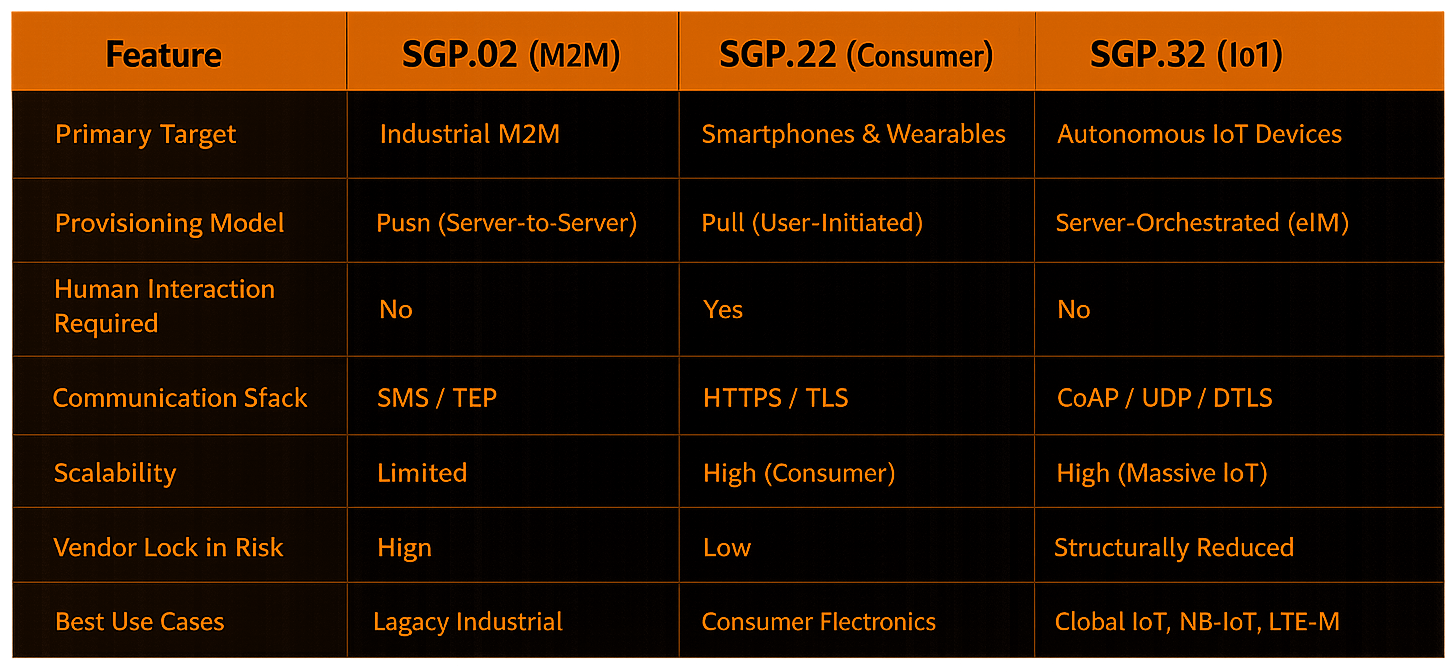
SGP.02, the original M2M standard, was designed for industrial environments where devices were static, long-lived, and tightly coupled to a single operator relationship. While it introduced remote provisioning, it relied on a complex server-to-server push model that required deep integration between the SIM vendor, the subscription manager, and the mobile network operator. In practice, this resulted in high switching costs and long-term vendor lock-in.
SGP.22, developed for consumer devices such as smartphones and wearables, solved many of these problems by introducing a pull-based model with a simplified backend architecture. However, it assumed the presence of a human user to trigger profile downloads, making it unsuitable for autonomous IoT deployments.
SGP.32 was created to bridge this gap. It combines the lightweight, scalable backend model of consumer eSIM with a server-driven orchestration layer that replaces the human user entirely. This architectural decision is what makes SGP.32 viable for massive IoT at global scale.

Technical architecture of SGP.32
At its core, SGP.32 introduces a modular architecture optimized for constrained networks and autonomous operation.
The eIM, or eSIM IoT Remote Manager, acts as the central orchestration platform. It enables enterprises, MVNOs, and connectivity providers to remotely trigger profile downloads, activations, suspensions, and deletions across entire device fleets using APIs. Instead of manual intervention, provisioning becomes a programmable process that can be embedded into enterprise workflows and device lifecycle management systems.
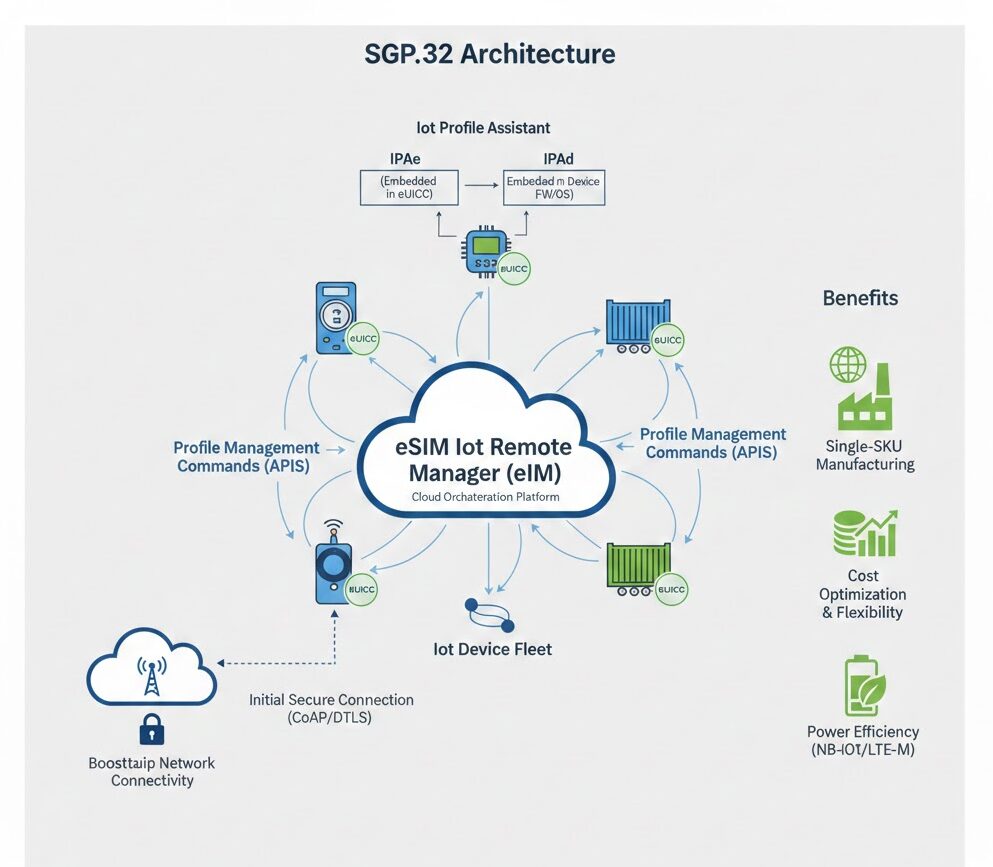
On the device side, the IoT Profile Assistant (IPA) functions as the execution layer. The IPA communicates with the eIM and translates remote instructions into actions on the eUICC. Depending on the implementation, the IPA can reside directly on the eSIM (IPAe) or within the device firmware or operating system (IPAd). This design choice has implications for device complexity, interoperability, and long-term maintenance.
To support low-power and low-bandwidth environments, SGP.32 replaces traditional HTTPS and TCP stacks with CoAP over UDP secured by DTLS. This protocol choice significantly reduces signaling overhead and power consumption, making SGP.32 suitable for NB-IoT and LTE-M deployments where battery life and network efficiency are critical.
Bootstrap connectivity in SGP.32 deployments
Despite its flexibility, every SGP.32-enabled device still requires an initial bootstrap connectivity profile to establish first contact with the eIM. This bootstrap profile is active at the moment the device powers on and enables the initial provisioning transaction.
From an operational perspective, bootstrap connectivity introduces strategic considerations that enterprises cannot ignore. The choice of bootstrap provider affects geographic reach, roaming behavior, activation reliability, and cost exposure. If the bootstrap profile lacks coverage or is commercially restrictive, it can become a new form of dependency that undermines the benefits of SGP.32.
Consider a common failure scenario: An enterprise deploys 50,000 smart meters across Latin America using a bootstrap profile limited to North American networks. Upon power-on in São Paulo or Buenos Aires, devices cannot establish initial connectivity, rendering remote provisioning impossible. The result is either a costly product recall or expensive manual intervention at each installation site—precisely the operational burden SGP.32 was designed to eliminate.
Best-practice deployments increasingly rely on neutral, globally roaming bootstrap profiles with limited data allowances and clear exit conditions. Once the target operational profile is downloaded, the bootstrap profile can be disabled or removed, ensuring long-term flexibility and cost control.
Hardware and Module readiness for SGP.32 devices
SGP.32 is a software-driven standard, but it must be supported by physical hardware across the device supply chain. Devices require eUICCs that are certified for SGP.32, along with cellular modules and firmware capable of supporting IPA functionality.
Not all existing IoT hardware platforms are compatible. In many cases, SGP.32 support requires newer module generations or firmware updates that must be planned during the product design phase. OEMs must also decide whether to implement IPA functionality on the eSIM itself or within the device, a choice that affects development timelines, certification complexity, and interoperability across networks. Hardware readiness is therefore a key procurement and design consideration, particularly for enterprises planning large production runs or long device lifecycles.

Key Benefits for enterprise IoT
The adoption of SGP.32 delivers tangible operational and commercial advantages for enterprises operating at scale.
One of the most significant benefits is single-SKU manufacturing, which allows organizations to produce a single hardware variant for global deployment. Devices can be shipped worldwide with a bootstrap profile and provisioned locally upon activation, reducing inventory complexity and accelerating time to market.
SGP.32 also shifts negotiating power away from network providers and toward enterprises. By enabling remote profile switching without physical intervention or bilateral negotiations, organizations gain the ability to optimize connectivity based on price, coverage, or performance over time. This directly reduces total cost of ownership and mitigates long-term risk.
In addition, the protocol efficiency of SGP.32 supports lower power consumption, extending battery life and enabling truly long-lived, “deploy-and-forget” use cases.
Interoperability and certification readiness
Although SGP.32 is a GSMA-approved specification, real-world interoperability is still evolving. Differences in eIM implementations, IPA behavior, and module firmware mean that not all solutions are equally mature.
In practice, enterprises frequently encounter integration challenges that slow deployment. For example, a certified eUICC from vendor A may exhibit unexpected behavior when paired with a cellular module from vendor B and managed by eIM platform C, even when all three components individually claim SGP.32 compliance. Profile download timeouts, inconsistent bootstrap handling, and edge-case failures during network handover remain common in first-generation deployments. These issues typically surface during pilot programs rather than laboratory testing, underscoring the importance of production-scale validation.

Operational use cases
By 2026, SGP.32 is expected to underpin a wide range of production IoT deployments. In logistics, devices can switch seamlessly between international and local profiles as they cross borders, avoiding permanent roaming restrictions. In utilities, long-lived meters can be re-provisioned if commercial terms change years after installation. In automotive applications, SGP.32 enables resilient fallback connectivity for safety-critical services.
These use cases demonstrate that SGP.32 is not theoretical. It is already shaping how global IoT systems are designed and operated.
Migration from SGP.02 to SGP.32
While SGP.32 is the strategic direction, most existing IoT estates are still based on SGP.02. Migration must therefore be approached pragmatically.
SGP.02 devices cannot be converted to SGP.32 through software alone, meaning coexistence is inevitable. Leading enterprises are addressing this by standardizing SGP.32 for all new deployments while maintaining legacy platforms until natural device refresh cycles allow phase-out. This approach minimizes disruption while enabling gradual modernization.
During the transition period, enterprises face dual operational complexity: managing two parallel provisioning systems, maintaining separate vendor relationships, and operating different connectivity management platforms. This hybrid state requires careful planning around billing reconciliation, support workflows, and reporting infrastructure. Organizations should budget for 3–5 years of parallel operations for large-scale IoT estates, with dedicated resources to manage the complexity. Some enterprises mitigate this by selecting MVNOs or connectivity providers that offer unified platforms capable of managing both SGP.02 and SGP.32 devices through a single interface, reducing the operational burden during migration.

Enterprises should prioritize providers with proven interoperability testing, GSMA accreditation, and production-scale deployments. Validation in live environments remains a critical step before mass rollout. When evaluating suppliers, request evidence of successful multi-vendor integrations and ask for reference deployments of comparable scale and geographic distribution.
Comparison: SGP.02 vs. SGP.22 vs. SGP.32
Operational risk and security
SGP.32 complies with GSMA SAS-SM security requirements, ensuring encrypted and authenticated profile delivery. However, security does not end at certification. Enterprises must secure eIM APIs, enforce role-based access controls, and monitor provisioning activity to prevent misuse or compromise at scale.
A comprehensive operational security strategy is essential to protect large IoT fleets over multi-year lifecycles.
IPA implementation: IPAe vs IPAd trade-offs
One of the most important architectural decisions in an SGP.32 deployment is the choice between IPAe (Embedded IoT Profile Assistant) and IPAd (Device-based IoT Profile Assistant). While both approaches are compliant with the SGP.32 specification, they introduce different trade-offs across interoperability, development complexity, and long-term operational control.
With IPAe, the IoT Profile Assistant resides directly on the eUICC. This approach minimizes dependency on device firmware and cellular module implementations, making it particularly attractive for large-scale and standardized deployments. Because the provisioning logic is embedded within the eSIM itself, IPAe enables greater hardware portability and simplifies supplier diversification. OEMs can change modules or device platforms with minimal impact on the eSIM lifecycle management layer, which reduces integration risk and accelerates time to market.
IPAe also lowers long-term operational complexity. Since profile management behavior remains consistent regardless of device firmware updates, enterprises benefit from predictable provisioning behavior over multi-year lifecycles. For global IoT deployments with millions of devices, this consistency translates directly into lower support costs and reduced operational risk.
By contrast, IPAd places the IoT Profile Assistant within the device operating system or cellular module firmware. This approach allows deeper integration between connectivity management and device logic, including power management, application workflows, and conditional provisioning behavior. In advanced use cases, IPAd can enable tighter control over when and how profile changes occur, which may be valuable in highly customized or mission-critical devices.
However, IPAd introduces greater development and maintenance complexity. Firmware dependencies increase testing requirements, and any changes to provisioning logic may require device-level updates, which can be challenging once devices are deployed in the field. IPAd also creates stronger coupling between hardware, firmware, and connectivity strategy, reducing flexibility over the device lifecycle.
In practice, IPAe is often preferred for large-scale, multi-vendor, and cost-sensitive deployments, while IPAd is typically chosen for specialized devices where deep integration justifies the additional complexity. Selecting the appropriate IPA model early in the design phase is critical, as changing this decision later can have significant cost and operational implications.
SGP.32 cost structure, TCO, and ROI considerations
From a financial perspective, SGP.32 introduces a fundamental shift in the total cost of ownership (TCO) for IoT connectivity. While SGP.32-compatible eUICCs and supporting infrastructure may carry a slightly higher upfront cost compared to legacy SIM solutions, the long-term return on investment is driven by operational savings, commercial flexibility, and risk mitigation.
In traditional SIM-based or SGP.02 deployments, enterprises incur recurring costs related to physical SIM logistics, region-specific device variants, permanent roaming charges, and long-term contractual lock-in. Changing connectivity providers often requires renegotiation, manual processes, or physical intervention, all of which increase both direct costs and organizational friction.
SGP.32 reduces these costs by enabling remote profile switching, eliminating the need for multiple hardware SKUs, and allowing connectivity to be sourced dynamically throughout the device lifecycle. For large deployments, even modest reductions in per-device operational expenses can result in substantial savings when applied across hundreds of thousands or millions of devices over 10–15 years.
To illustrate: A deployment of 100,000 industrial sensors with a 10-year lifespan might incur $3–5 per device in additional upfront costs for SGP.32-capable hardware. However, eliminating multi-SKU inventory typically saves $2–4 per device in logistics and warehousing. Over the device lifetime, dynamic profile switching can reduce connectivity costs by 15–30% through competitive sourcing and elimination of permanent roaming surcharges.
For this example deployment, the net TCO improvement could range from $1.5M to $4M, with payback periods often under 24 months. These figures vary significantly based on deployment geography, device density, and existing carrier relationships, but the directional economics consistently favor SGP.32 for fleet sizes above 10,000 units.
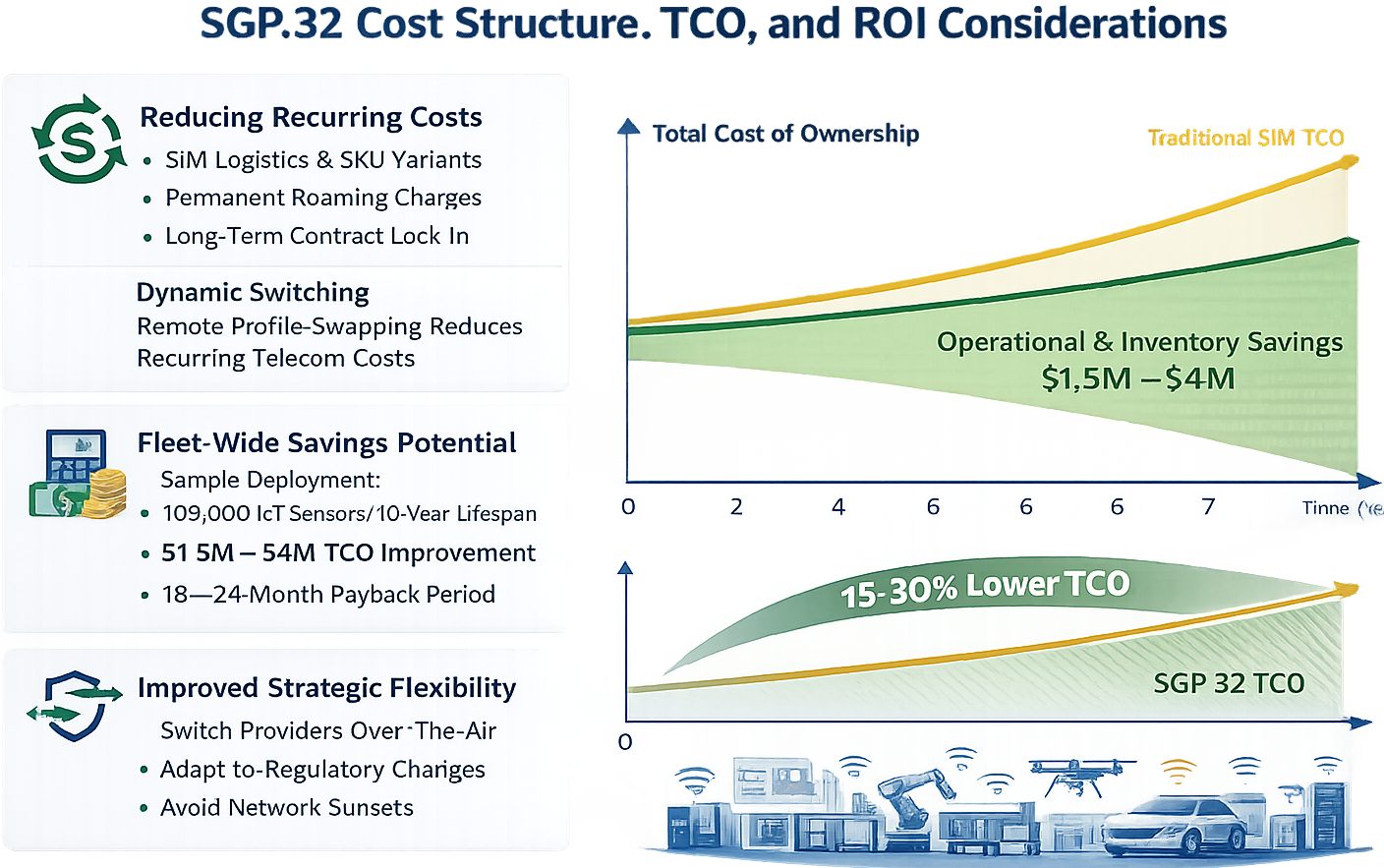
Beyond direct cost savings, SGP.32 delivers cost avoidance and risk reduction. Enterprises gain the ability to respond to price increases, coverage degradation, regulatory changes, or network sunsets by switching providers over the air. This flexibility protects long-term investments and improves negotiating leverage with connectivity suppliers.
When evaluated holistically, ROI from SGP.32 is typically realized not only through lower connectivity costs, but through faster deployment cycles, reduced inventory complexity, improved supplier competition, and greater resilience over the device lifecycle.
Frequently Asked Questions (FAQs)
Does SGP.32 replace SGP.02?
SGP.32 is the strategic successor for new IoT deployments. However, SGP.02 will continue to operate in existing estates for many years due to long device lifecycles.
Do I need special hardware for SGP.32?
Yes. Devices require SGP.32-compliant eUICCs and compatible cellular modules with appropriate firmware support.
Can SGP.32 operate on NB-IoT and LTE-M networks?
Yes. SGP.32 was explicitly designed for constrained networks and is well suited to NB-IoT and LTE-M environments.
What role do MVNOs play in SGP.32?
MVNOs provide connectivity, eIM platforms, and lifecycle management services, acting as orchestration and integration partners for enterprises.
Is SGP.32 available globally today?
SGP.32 complies with GSMA SAS-SM security standards, ensuring encrypted and authenticated profile delivery. Enterprises must still implement robust operational security controls.
Is SGP.32 secure?
Availability varies by region and provider. While the standard is global, readiness depends on carrier, module, and platform support.
Summary about SGP.32
SGP.32 marks a decisive shift from workaround-driven IoT connectivity to a standardized, scalable, and commercially flexible model. It enables enterprises, OEMs, and MVNOs to deploy global IoT solutions with greater control, lower risk, and improved long-term economics.
As the IoT market matures, SGP.32 is no longer an emerging option. It is becoming a strategic requirement for any organization planning to deploy connected devices at global scale. For those evaluating providers, platforms, and deployment partners, resources such as the MVNO Index play a critical role in navigating this rapidly evolving ecosystem.
Generic Information