Introduction about Multi-IMSI Connectivity for MVNOs & IoT
As global connectivity demands evolve from simple roaming to mission-critical resilience, Multi-IMSI technology has emerged as a cornerstone for international deployments. This architecture allows a single SIM, eSIM, or iSIM to host multiple “digital identities,” enabling local-level performance on a global scale.
For enterprises, MVNOs, and IoT operators, Multi-IMSI transforms connectivity from a fixed dependency into a flexible resource. It eliminates the risks of permanent roaming bans, reduces latency, improves coverage, and provides a robust failover mechanism—making it a strategic necessity in an increasingly fragmented regulatory landscape..
All the things you need to know about Multi-IMSI
1. What is Multi-IMSI?
2. What is an IMSI?
3. How IMSI Enables Multi-IMSI
4. Multi-IMSI vs Single-IMSI
5. Advantages & Disadvantages of Multi-IMSI
6. How Multi-IMSI Works
7. How to Implement Multi-IMSI
8. How to Manage Multi-IMSI
9. The Costs of Multi-IMSI
10. The Value of Multi-IMSI for MVNOs
11. How Multi-IMSI Benefits IoT Deployments
12. Multi-IMSI Enhances the Subscriber Experience
13. Common Multi-IMSI Use Cases
14. Multi-IMSI and eSIM: Complementary Technologies
15. Most common mistakes
16. The Future of Multi-IMSI
17. Frequently Asked Questions
18. Summary of Multi-IMSI
What is Multi-IMSI?
Multi-IMSI (Multiple International Mobile Subscriber Identity) is a cellular connectivity architecture that allows a single SIM, eSIM, or iSIM to store and operate multiple network identities simultaneously. Each identity is tied to a specific mobile network operator, enabling a device to act as a local subscriber in different countries.
Unlike traditional single-IMSI models, where devices depend entirely on roaming agreements, Multi-IMSI introduces a multi-home identity approach. Network selection can be optimized for coverage, performance, cost, and regulatory compliance, resulting in resilient, globally deployable solutions.
What is an IMSI?
An IMSI is the primary identifier used by cellular networks to recognize and authenticate a subscriber. It is stored securely on the SIM and transmitted during network registration. Without a valid IMSI, a device cannot access cellular services.
An IMSI consists of three components:
- Mobile Country Code (MCC): Identifies the subscription’s home country.
- Mobile Network Code (MNC): Identifies the specific operator.
- Mobile Subscription Identification Number (MSIN): Uniquely identifies the subscriber within the operator’s system.
The IMSI determines which network handles traffic, applies policies, and manages billing, it is effectively the device’s “digital identity.”
How IMSI Enables Multi-IMSI
In a traditional SIM model, only one IMSI is present. The device always presents that IMSI to the network, regardless of location. If the device moves outside its home country, it connects through roaming agreements.
With multi-IMSI, several IMSIs are stored on the SIM or eSIM. Each IMSI corresponds to a different operator or regional network partner. The device or connectivity platform can select which IMSI should be active at any given time.
When an IMSI is activated, the device registers on the corresponding network as if it were a native subscriber. From the network’s perspective, there is no difference between a multi-IMSI device and a locally issued SIM. This is what enables local breakout, improved coverage, and flexible routing.
Multi-IMSI vs Single-IMSI
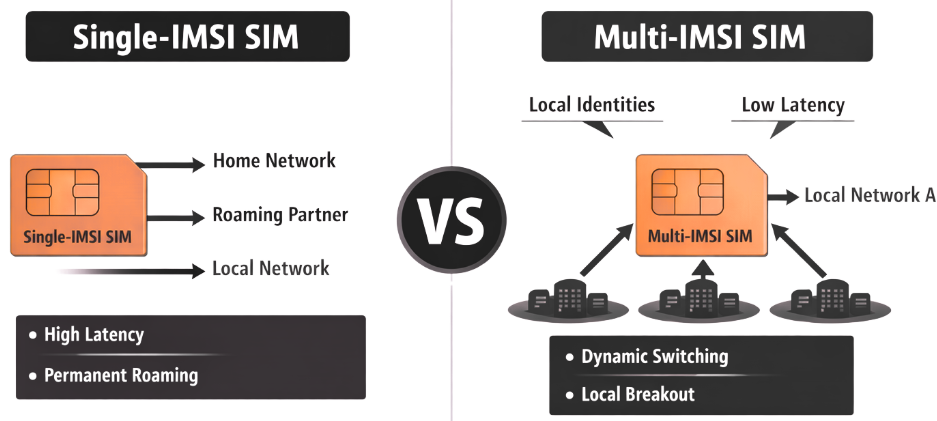
The fundamental difference between these two models lies in network sovereignty. A Single-IMSI SIM is a “guest” when it leaves its home country, relying entirely on the roaming agreements negotiated by its one parent carrier. This often leads to “throttled” speeds or high latency as data is tunneled back to the home country (tromboning).
In contrast, a Multi-IMSI SIM carries multiple “home” identities. When the device crosses a border, the SIM can swap its identity to a local one. This transforms the device from a roaming guest into a local subscriber. While Single-IMSI solutions are simpler and cheaper for domestic-only use, they lack the failover capabilities and regulatory compliance (bypassing permanent roaming restrictions) that Multi-IMSI provides for global or mission-critical applications.
Feature
Primary Driver
Network Identity
Redundancy
Regulatory Risk
Single-IMSI
Cost / Simplicity
Fixed to one Home MNO
Limited to Roaming partners
High (Permanent Roaming)
Multi-IMSI
Coverage / Resilience
Multiple Local Identities
High (Multiple Home networks)
Low (Local Breakout)
Advantages & Disadvantages of Multi-IMSI
Advantages
- Improved geographic coverage: Devices can attach to multiple local networks rather than relying on a single roaming partner. This reduces dead zones and improves service consistency.
- Higher service availability: If one network experiences congestion or outage, another IMSI can be activated, allowing the device to reconnect automatically.
- Reduced roaming dependency: Traffic can be handled as local traffic in many countries instead of permanent roaming, which lowers costs and avoids regulatory restrictions.
- Commercial flexibility: Enterprises and service providers can negotiate rates with multiple operators and select the most cost-effective option.
- Simplified global deployments: One SIM SKU can support many regions, reducing logistics complexity.
Disadvantages
- Greater system complexity: Managing multiple IMSIs requires orchestration platforms, policies, and monitoring tools.
- Higher SIM or eSIM cost: Multi-IMSI profiles typically cost more than single-IMSI alternatives due to the specialized software (applets) required.
- Regulatory considerations: While it helps bypass permanent roaming bans, some countries have strict registration requirements for local IMSIs.
- Troubleshooting challenges: Diagnosing connectivity issues can be harder when devices move between networks.
- Vendor dependency: Quality depends heavily on the SIM provider and their operator relationships.
How Multi-IMSI Works
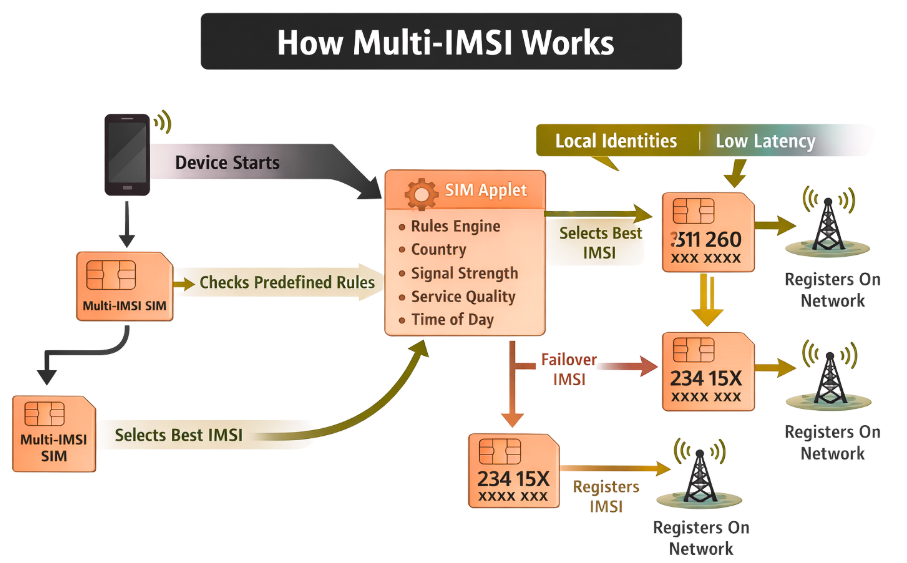
Multiple IMSIs are stored securely in the SIM’s memory. Only one IMSI is active at a time. The core of this technology is a SIM Applet a specialized software application running on the SIM’s operating system.
This applet acts as a rules engine to determine which IMSI should be used based on predefined logic. This logic may consider country location (via the MCC), network signal strength, service quality, time of day, or commercial priority. One of the greatest technical advantages of the Multi-IMSI applet is the ability to bypass Steering of Roaming (SoR), where a local carrier might otherwise force the device onto a lower-quality roaming partner.
Switching can occur during boot, periodically, or when performance degrades. The process is typically transparent to the user and does not require physical interaction.
How to Implement Multi-IMSI
Implementation starts with selecting a SIM or eSIM provider that supports multi-IMSI. The provider supplies IMSI pools mapped to different countries and networks.
A connectivity management platform is then integrated to manage IMSI selection and monitoring. Policies are configured to define when switching occurs and which IMSIs are preferred.
Devices are tested across multiple networks and regions. After validation, large-scale deployment can begin. Proper planning at this stage reduces long-term operational issues.
How to Manage Multi-IMSI
Ongoing management requires centralized visibility. Operators and enterprises monitor usage, network performance, and IMSI status through dashboards and APIs.
Policies are adjusted over time to reflect changing commercial agreements or coverage priorities. Alerts are configured to detect anomalies such as “ping-ponging” (excessive switching between networks) or failed registrations.
Lifecycle management processes handle activation, suspension, and retirement of IMSIs and SIMs. This ensures long-term operational stability.
The Costs of Multi-IMSI
Multi-IMSI introduces higher upfront costs compared to single-IMSI SIMs. There are also platform and integration expenses.
However, these costs are often offset by savings from reduced roaming fees, lower downtime, fewer field interventions, and stronger negotiating leverage with operators. When evaluated over the full device lifecycle, multi-IMSI frequently results in a lower total cost of ownership (TCO) for global deployments.
The Value of Multi-IMSI for MVNOs
Multi-IMSI gives MVNOs the ability to operate beyond the limitations of a single host network. Instead of being commercially and technically anchored to one operator per country, MVNOs can aggregate multiple operator relationships into a single connectivity proposition. This shifts the MVNO business model from simple resale toward connectivity orchestration and service enablement.
By controlling multiple IMSI identities, MVNOs gain greater flexibility in how they design products, price services, and negotiate wholesale agreements. They can introduce differentiated enterprise offerings, optimize traffic routing, and reduce dependency on any single network partner. Over time, this strengthens bargaining power and improves margin stability.
Multi-IMSI also accelerates international expansion. MVNOs can launch services in new markets without deploying separate physical SIM SKUs or building deep, country-specific integrations for each product line. This lowers market-entry friction and enables faster commercialization.
Example 1:
An enterprise-focused MVNO builds a global IoT offering using multi-IMSI SIMs. Devices ship with IMSIs from several tier-1 operators across Europe, North America, and Asia. The MVNO dynamically activates the best local IMSI when devices are installed, allowing the company to sell a single global connectivity plan instead of country-specific subscriptions.
Example 2:
A travel SIM MVNO uses multi-IMSI to present local identities in more than 40 countries. Customers receive better local performance and lower latency compared to traditional roaming. The MVNO markets this as “local network experience worldwide,” creating a clear product differentiator.
Example 3:
A wholesale MVNO aggregates IMSI resources from multiple MNO partners and resells connectivity to smaller virtual operators. Multi-IMSI becomes the technical foundation for a platform business, enabling the MVNO to monetize orchestration rather than just SIM cards.
How Multi-IMSI Benefits IoT Deployments
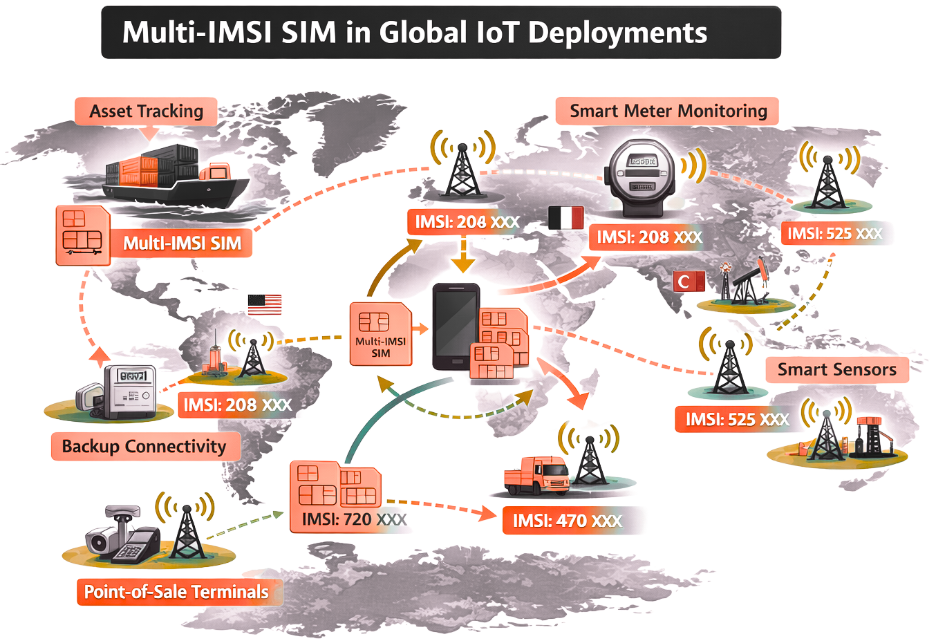
Multi-IMSI provides IoT deployments with a level of resilience and flexibility that is difficult to achieve using single-IMSI or roaming-centric models. Many IoT devices operate unattended, in remote locations, or across borders. In these environments, physical SIM replacement is impractical or impossible.
By enabling devices to switch between multiple network identities, multi-IMSI ensures that connectivity can be adapted throughout the device lifecycle. This protects long-term investments and reduces operational risk, particularly in countries with Permanent Roaming restrictions (like Brazil or Turkey) where a roaming SIM may be disconnected after 90 days.
Example 1:
A global asset-tracking company deploys trackers on shipping containers. As containers move between continents, the device switches IMSI to attach to local networks instead of relying on roaming. This improves coverage in ports and industrial zones.
Example 2:
A utility provider installs smart meters expected to remain in the field for 15 years. If the original network partner changes pricing or sunsets technology, the utility can move devices to another operator using an alternate IMSI without replacing hardware.
Example 3:
An industrial equipment manufacturer sells machines worldwide. Multi-IMSI allows the same device model to be shipped to every market, while connectivity is localized during commissioning.
Multi-IMSI Enhances the Subscriber Experience
For subscribers, multi-IMSI primarily improves the quality and consistency of their connectivity experience. Although most users are unaware that multi-IMSI is in use, they directly benefit from better coverage, fewer service interruptions, and more predictable performance.
Multi-IMSI reduces dependence on traditional roaming, which often introduces latency (due to traffic being “home-routed” back to the origin country), congestion, and higher costs. Instead, users connect as local subscribers in many countries.
Example 1:
A business traveler uses a multi-IMSI-enabled mobile service. When arriving in another country, the phone attaches to a local network using a local IMSI. Data speeds feel similar to domestic usage.
Example 2:
A logistics worker carries a rugged handheld device across multiple countries. Connectivity remains stable without manual SIM swaps or configuration changes.
Example 3:
A consumer purchases a global travel SIM that automatically selects the best local network in each destination, avoiding surprise roaming charges.
Common Multi-IMSI Use Cases
The Multi-IMSI use cases. Multi-IMSI is most valuable in environments where devices must remain connected across borders, operate for long periods without human intervention, or require extremely high service availability. In these scenarios, traditional single-IMSI or roaming-based models introduce cost, coverage, and operational risks that multi-IMSI is designed to reduce.
International asset tracking
Logistics companies track containers, pallets, and high-value shipments as they move through ports, warehouses, and transportation corridors around the world. Coverage quality varies significantly between networks in different countries. Multi-IMSI allows tracking devices to attach to local networks in each region, improving location accuracy, reducing packet loss, and avoiding roaming restrictions that can block service after prolonged use.
Fleet management and telematics
Commercial vehicles frequently cross national borders and operate in rural or remote areas. A multi-IMSI SIM enables vehicles to switch between multiple operators when signal quality drops. This ensures continuous access to vehicle diagnostics, driver behavior data, and safety systems without requiring hardware changes.
Smart utility metering
Electricity, gas, and water meters are typically deployed for ten to twenty years. During that time, operators may change pricing, merge, or retire network technologies. Multi-IMSI allows utilities to migrate meters to alternative networks without replacing installed hardware, protecting long-term investments.
Point-of-sale terminals
Retailers operate thousands of payment terminals across different countries and regions. Transactions must complete reliably and quickly. Multi-IMSI ensures terminals can select the best local network, improving transaction success rates and reducing downtime that directly impacts revenue.
Connected medical devices
Remote patient monitoring devices and portable diagnostic equipment depend on reliable connectivity. Multi-IMSI improves availability by allowing devices to move between networks if coverage degrades, supporting continuous data transmission for clinical applications.
Industrial sensors and monitoring systems
Factories, oil fields, mines, and construction sites often operate in areas with inconsistent coverage. Multi-IMSI enables sensors to connect through whichever network provides the best signal at the site, improving reliability of telemetry and alerting systems.
Smart city infrastructure
Smart lighting, parking sensors, traffic systems, and environmental monitors are deployed citywide. Municipalities may work with multiple network operators over time. Multi-IMSI provides the flexibility to change networks without replacing thousands of devices.
Consumer & enterprise wearables
Wearables sold globally must deliver consistent user experience regardless of location. Multi-IMSI allows manufacturers to ship one device model worldwide and localize connectivity at activation.
Travel connectivity solutions
Travel SIMs and eSIM products use multi-IMSI to present local identities in many countries. Users receive better speeds and lower latency than traditional roaming, improving customer satisfaction.
Backup and failover connectivity
Routers, ATMs, digital signage, and security systems often rely on cellular as a secondary connection. Multi-IMSI ensures failover connectivity remains available even if one operator’s network is unavailable.
Multi-IMSI and eSIM: Complementary Technologies
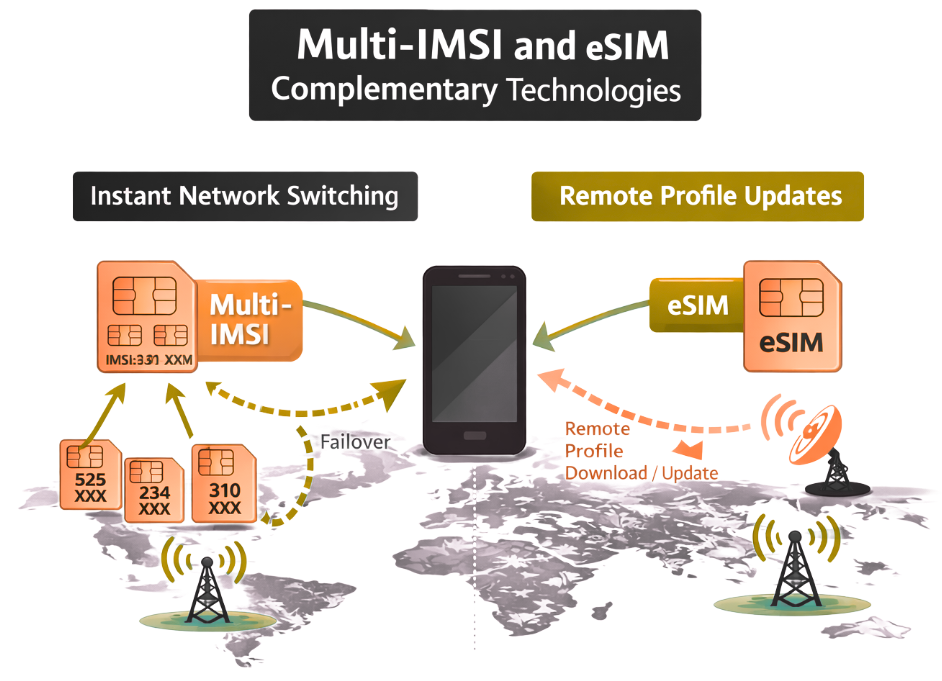
Multi-IMSI and eSIM are often mentioned together because both enhance global connectivity, but they solve different problems. Multi-IMSI focuses on storing multiple network identities on a single SIM, enabling devices to switch instantly between operators for roaming optimization, redundancy, or network fallback. eSIM, on the other hand, allows profiles to be downloaded and managed remotely, providing flexibility over the lifecycle of a device and simplifying long-term connectivity management.
These technologies are not mutually exclusive. Many modern IoT deployments combine multi-IMSI and eSIM to achieve both instant network switching and remote operator management. For example, a shipping container tracker can use multi-IMSI to connect to the best available network in real time, while also leveraging eSIM capabilities to update or replace operators without hardware changes over the years.
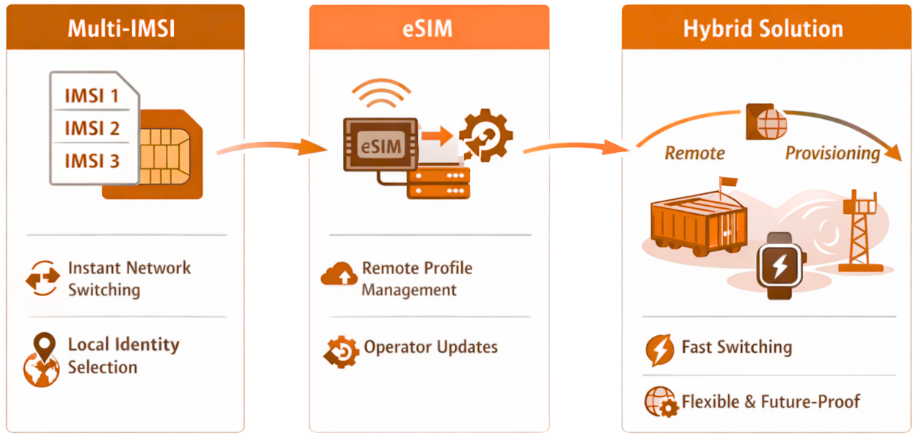
By understanding the roles of each technology, enterprises, MVNOs, and IoT solution providers can design connectivity architectures that are resilient, cost-effective, and future-proof. Multi-IMSI delivers immediate operational benefits, while eSIM provides strategic flexibility for long-lived or evolving deployments.
Most common Mistakes
1. Managing APNs Incorrectly
Each IMSI in a Multi-IMSI pool often requires a different APN (Access Point Name).
The Reality: A major failure point in deployments is when the SIM switches to a new IMSI, but the device hardware continues trying to use the old APN. Unless you use a Universal APN (provided by the vendor) or have “APN-aware” firmware, the device will show “Registered” but will be unable to transmit data.
2. Ignoring “Steering of Roaming” (SoR)
MNOs (Mobile Network Operators) often use “Steering of Roaming” to force a device onto their cheapest partner network, even if that network has a weak signal.
The Reality: A common mistake is not verifying that your Multi-IMSI provider has a “steering-immune” applet. Without this, the local network might keep kicking your device off the preferred IMSI, causing a “switching loop” that drains the battery.
3. Underestimating “Blind Time” during Switching
Engineers often assume switching between IMSIs is instantaneous.
The Reality: When a SIM applet swaps an IMSI, the modem must perform a “stack restart.” This can cause 30 to 90 seconds of downtime (blind time). If your IoT device is heartbeat-sensitive or sends critical alarms, you must design your firmware to handle this gap without rebooting or failing.
4. Confusing Multi-IMSI with eSIM (eUICC)
This is the #1 mistake. Many believe they are the same thing.
The Reality: Multi-IMSI is a feature (multiple identities on one SIM), while eSIM is a hardware/standard (the ability to download those identities over-the-air). You can have Multi-IMSI on a traditional plastic SIM without it being an eSIM.
5. Failing to Account for “Permanent Roaming” Laws
Some manufacturers assume a single roaming IMSI will work everywhere forever.
The Reality: Countries like Brazil, Turkey, and China are aggressive about banning devices that roam for more than 90 days. The mistake is not having a “Local IMSI” in your pool for these specific regions. Without a local identity, your devices will eventually be blacklisted by the local regulator.
6. The “Ping-Pong” Effect
This occurs when the switching logic is too sensitive.
The Reality: If your logic says “Switch if signal drops below -100dBm,” and the signal hovers at -101dBm, the device might switch back and forth constantly. This consumes massive amounts of power and data. You must implement Hysteresis (e.g., stay on the new network for at least 15 minutes before considering another switch).
The Future of Multi-IMSI
Multi-IMSI is becoming part of a broader shift toward software-defined connectivity. It increasingly works alongside eSIM, iSIM, and remote SIM provisioning.
Future platforms will combine multi-IMSI with dynamic profile downloads and AI-driven network selection. This will further automate optimization. Multi-IMSI will remain relevant, especially for fast switching scenarios, legacy environments, and deployments requiring immediate fallback.
Frequently Asked Questions (FAQs)
Can multi-IMSI work with eSIM?
Yes. Multi-IMSI identities can be stored on eSIMs, combining instant switching with remote profile management.
How many IMSIs can a multi-IMSI SIM store?
The number varies by SIM design but typically ranges from 3–10 for consumer devices and more for IoT or enterprise-grade modules.
Does multi-IMSI increase SIM cost?
Yes, slightly. Costs are offset by savings on roaming fees, fewer SIM replacements, and improved uptime.
Can multi-IMSI devices switch automatically?
Yes. Rules can be configured for automatic selection based on network quality, cost, or operator preference.
Is multi-IMSI secure?
SGP.32 complies with GSMA SAS-SM security standards, ensuring encrypted and authenticated profile delivery. Enterprises must still implement robust operational security controls.
Is SGP.32 secure?
Yes, when managed correctly. Enterprises must implement strong encryption, secure management platforms, and policies to prevent misuse.
Summary about Multi-IMSI
Multi-IMSI technology delivers resilience, cost savings, and global connectivity for enterprises, MVNOs, and subscribers. By storing multiple IMSIs on a single SIM, it allows devices to switch networks instantly, reduce roaming fees, and maintain service continuity. When combined with eSIM, it provides both operational and strategic flexibility, making it a critical technology for modern IoT deployments and global mobility solutions.
Subjects about SIM (Cards), eSIM and iSIM