Introduction about Starting a M2M & IOT MVNO (Mobile Brands)
M2M & IOT MVNOs provide M2M (machine-to-machine)/telemetry services or Internet of Things (IOT) connectivity, solutions & services. Enabling companies and consumers to enjoy new ways to manage and monitor their businesses, appliances, devices, lives, and health.
Clearly there is enormous potential and this market has a huge growth perspective the coming decades. M2M / IOT communications offer a world of opportunities to all parties involved, from product manufacturers, to MNOs, MVNOs through to end users.
What do you need to know about starting a M2M or IOT MVNO
- What are the advantages and disadvantages ?
- What are the Revenue sources and Pricing strategy?
- What are suitable segments?
- What kind of Mobile bundles are typically used?
- What kind of ARPU can you expect?
- What is the Go-to-Market Strategy?
- What are some points to think of for the Marketing Plan?
- What kind of financing is to be expected?
- What kind of MVNO type is typically used?
- What is the expected time for the launch?
- What is the expected impact of 5G?
- What is the expected impact of eSIM?
- Frequently Asked Questions
- Summary
What are the advantages and disadvantages of M2M & IOT MVNOs?
Advantages: They provide innovative solutions in IoT and telemetry, revolutionizing industries with smart technologies. Their services enable efficient management and monitoring, paving the way for the future of connected devices.
Disadvantages: Technical complexities in M2M integration demand expertise. Ensuring compatibility and reliability across diverse devices and platforms requires continuous advancements and adaptability.
What are the Revenue sources and Pricing strategy ?
Revenue Sources: Generates revenue from providing IoT solutions to businesses, including device connectivity, data analytics, and monitoring services.
Pricing Strategy: Offers subscription-based pricing models for businesses, tailored to the number of connected devices and data usage.
What are suitable segments/markets?
- Fleet Management: Offering M2M services for tracking vehicles, optimizing routes, and monitoring fuel consumption for businesses with fleets.
- Health Monitoring: Providing telemetry services for remote patient monitoring, enabling healthcare providers to track patients’ vital signs and health data in real-time.
- Environmental Monitoring: Offering M2M solutions for monitoring environmental factors such as air quality, pollution levels, and climate data in various locations.
- Industrial Automation: Providing telemetry services for manufacturing plants, enabling remote monitoring of machinery, predictive maintenance, and production optimization.
- Smart Agriculture: Offering M2M solutions for precision farming, allowing farmers to monitor soil moisture, crop health, and automate irrigation systems.
- Energy Management: Providing telemetry services for energy companies to monitor power grids, detect faults, and optimize energy distribution.
- Retail Inventory: Offering M2M services for retailers to automate inventory management, track product movement, and prevent stockouts.
- Home Automation: Providing telemetry services for smart homes, enabling homeowners to control lighting, temperature, and security systems remotely.
- Traffic Management: Offering M2M solutions for smart cities, allowing real-time monitoring of traffic flow, congestion, and optimizing traffic signal timings.
- Water Management: Providing telemetry services for water utilities, enabling remote monitoring of water quality, leak detection, and water distribution.

What kind of Mobile bundles are typically used for M2M & IOT MVNOs?
Data: High demand for real-time data transmission from connected devices, sensors, and telemetry systems. Use case: Health monitoring, vehicle tracking, environmental sensors.
Voice: Negligible demand, communication happens through data channels. Use case: Data transmission only, no voice communication.
SMS: Low demand, replaced by specialized protocols for device communication. Use case: Device alerts, system notifications.
What kind of ARPU can you expect?
ARPU: Low to High.
Why: M2M/IOT MVNOs provide specialized services for machine-to-machine communication, serving industries like healthcare, automotive, and IoT. They offer value-added services that command higher pricing. Mostly the ARPU is low, and it is therefore important to get large volumes to survive as an MVNO.
Where It Is Based On: ARPU can be low or high depending specialized services, including real-time data transmission and telemetry, crucial for various industries.
You need to work out the details in your Financial Plan.

What is the Go-to-Market Strategy for M2M & IOT MVNOs?

Collaborate with IoT device manufacturers for joint promotions. Offer comprehensive solutions for specific industries like healthcare and manufacturing, showcasing the efficiency gains. Provide robust technical support and conduct workshops to educate potential clients about the benefits of IoT technology.
- Target Audience: Industries relying on IoT, healthcare providers, automotive companies, and businesses requiring M2M communication.
- Pricing Strategy: Tiered pricing based on data usage, specialized plans for healthcare monitoring, real-time analytics services for businesses.
- Distribution Channels: IoT expos, healthcare conferences, and partnerships with IoT device manufacturers.
- Promotion: Webinars on IoT advancements, case studies on successful telemetry implementations, and whitepapers on industry-specific solutions.
- Customer Support: IoT integration assistance, real-time troubleshooting for telemetry issues, and dedicated support for healthcare monitoring.
What are points to think of for the Marketing Plan?
Partner with IoT device manufacturers, participate in industry exhibitions, and conducts workshops to educate businesses about IoT benefits. You need to work out below points in your Marketing Plan.
USP: Specialized IoT solutions, real-time data transmission, and industry-specific telemetry services.
Content Creation: Industry-specific IoT guides, case studies on successful telemetry implementations, and whitepapers on IoT advancements.
Promotions: Discounts on bulk IoT device purchases, free trials for telemetry analytics services, and exclusive access to IoT webinars.
Partnerships: Partner with IoT device manufacturers, healthcare equipment providers, and businesses specializing in IoT solutions.
Feedback Loop: Collaborate with industries to understand their unique telemetry needs, and analyze data usage patterns to optimize services.

What kind of financing is to be expected for M2M & IOT MVNOs?

Financing: Moderate
These MVNOs cater to industries relying on IoT solutions. Investment is necessary for IoT platform development, partnerships with device manufacturers, and specialized customer support for IoT implementations.
Financing requirements depend on the complexity of IoT solutions offered.
You need to work the details in your Financial Plan.
What kind of MVNO type is typically used for M2M & IOT MVNOs?
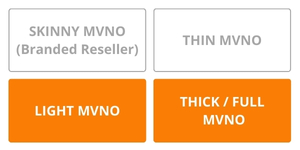
MVNO Type: Light or Thick/Full MVNO
M2M/IOT MVNOs require extensive control over their IoT solutions, including device management, data transmission, and specialized customer support.
Light or Full MVNOs provide the level of customization needed for serving IoT and telemetry applications.
See also: Different types of MVNOs
What is the expected time to launch?
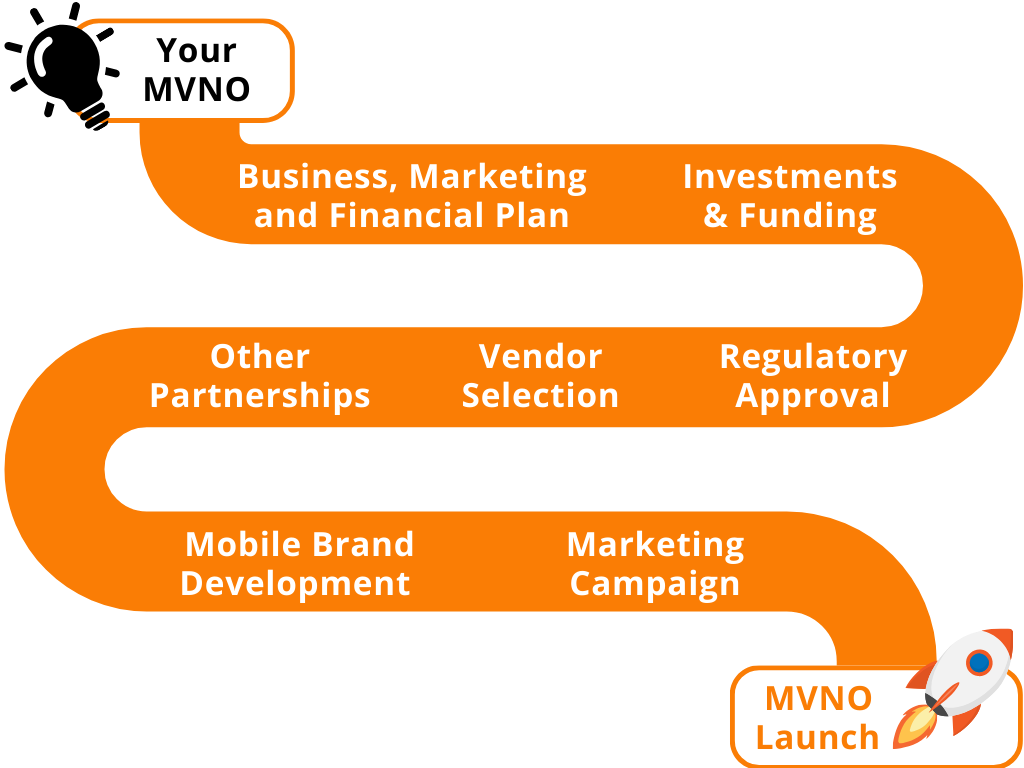
Expected Time to Launch: 9-15 months
M2M/IOT MVNOs require the development of sophisticated IoT platforms, partnerships with device manufacturers, and specialized customer support. Implementing IoT solutions and ensuring their seamless operation takes time.
You might be able to expedite the launch process with a specific Strategy: For example, use pre-built IoT platforms for rapid prototyping. Collaborate with device manufacturers for pre-integrated solutions. Implement remote monitoring and diagnostics for quick issue resolution.
What is the expected impact of 5G for M2M & IOT MVNOs?
5G facilitates rapid data exchange for IoT devices, enabling real-time monitoring and analytics. M2M/IOT MVNOs can offer advanced solutions for industries like healthcare, transportation, and manufacturing, driving IoT adoption. For more details see the Mobile Network section.

What is the expected impact of eSIM for M2M & IOT MVNOs?
Frequently Asked Questions
What are M2M and IoT MVNOs?
M2M (Machine‑to‑Machine) and IoT (Internet of Things) MVNOs are mobile virtual network operators specialised in providing connectivity for devices rather than traditional human users. They support sensors, trackers, meters, industrial equipment, and other connected devices with tailored data plans and management capabilities.
How do M2M and IoT MVNOs differ from consumer MVNOs?
Unlike consumer MVNOs, which focus on subscriber voice and data plans, M2M and IoT MVNOs design connectivity for devices. This means offering small data packages, remote provisioning, long lifecycle support, specialised billing models, and platforms for device management and analytics.
What use cases do M2M and IoT MVNOs support?
M2M and IoT MVNOs serve a wide range of use cases, including asset tracking, fleet management, smart utilities, industrial automation, healthcare monitoring, smart cities, agricultural sensors, and connected consumer products. Each use case has distinct connectivity and data requirements.
What are common connectivity technologies used by IoT MVNOs?
IoT MVNOs typically use cellular technologies such as NB‑IoT (Narrowband IoT), LTE‑M (Cat‑M1), 4G, and increasingly 5G, depending on the device needs. These technologies offer varying balances of power consumption, coverage, throughput, and latency for different IoT applications.
What are key challenges in operating an IoT or M2M MVNO?
Challenges include managing large numbers of connected devices, ensuring scalable platforms, handling device lifecycle and SIM/eSIM provisioning, integrating with backend systems, optimising data usage costs, and maintaining strong security and monitoring for deployed devices.
How do IoT MVNOs measure success?
IoT MVNO success can be measured by metrics such as device uptake rates, ARPU (Average Revenue Per Unit), network performance, uptime, customer retention, data usage efficiency, and operational cost optimisation. Clear KPIs help align solutions with business goals.
Summary
In summary, M2M & IOT MVNOs are poised to play a critical role in the future of the Internet of Things (IoT) by providing reliable and secure connectivity for machine-to-machine communication. This enables businesses across various industries, including healthcare, manufacturing, and agriculture, to remotely manage and monitor devices, optimizing operations and driving efficiency gains.
MVNO Business Models